Open Economy — Barriers to Trade & Trade Policy
GS Paper: III (Economy) | Subject: Economy — External Sector | Teacher: Shobit Uniyal (Vajiram & Ravi) | Class: 1 | Last updated: 2026-06-18
What this note is. This is Class 1 of the External-Sector module. No class transcript exists for this lecture — so the note is built faithfully from Handout-1, with light exam framing added and clearly flagged. (Class 2, on the foreign exchange rate, has a full transcript and is in its own note.)
Table of Contents
- Open economy vs closed economy
- Barriers to trade (tariff & non-tariff)
- Commercial policy — free trade vs protectionism
- Arguments in favour of free trade
- Arguments in favour of protectionism
- Exam focus
- Current Affairs
1. Open economy vs closed economy
- Closed economy — has no economic transactions with the outside world: no imports, no exports, and no flow of capital to or from abroad. It is completely self-sufficient. In reality no nation has a completely closed economy — even a largely closed economy still imports essentials like crude oil and pharmaceutical drugs.
- Open economy — freely engages in economic transactions with the outside world. Here "freely" means without restriction. Again, no nation has a completely open economy — even the most open economies impose some restrictions on transactions with the outside world.
So every real economy sits somewhere on a spectrum between the two extremes.
2. Barriers to Trade
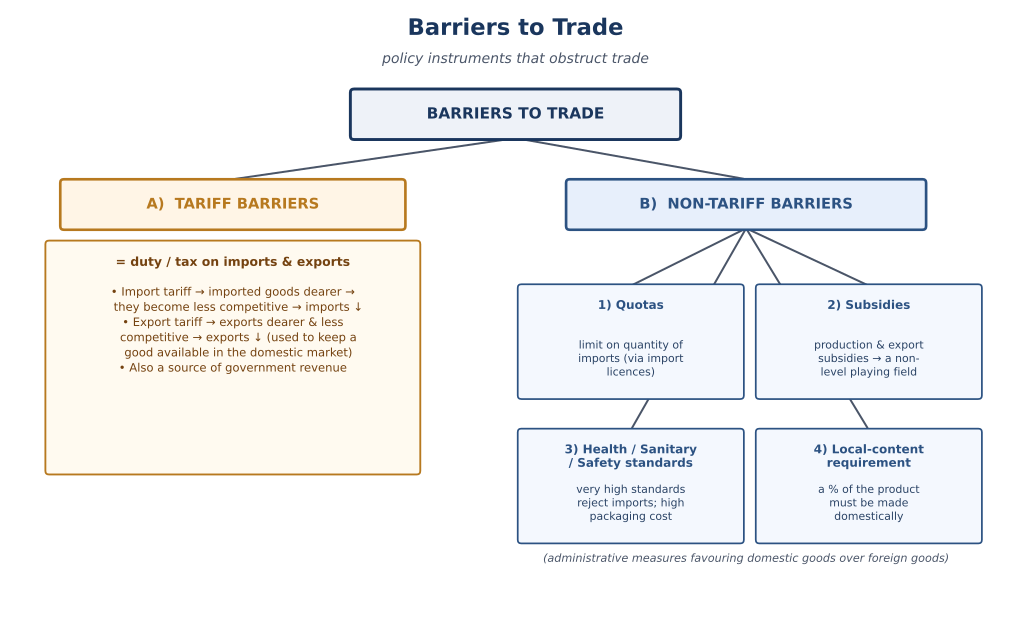
The policy instruments that obstruct trade are called barriers to trade. They are of two broad types — tariff and non-tariff barriers.
A) Tariff barriers
A tariff is the duty or tax imposed by the government on the import and export of goods.
- A tariff on imports raises the price of imported goods, making them less competitive, so imports are discouraged.
- A tariff on exports makes exported items costlier and less competitive in the international market, so exports are discouraged. Export tariffs are usually raised on certain items when the government wants to keep them available in the domestic market (which might otherwise be exported).
- Tariffs are also a source of government revenue.
B) Non-tariff barriers
These are the administrative measures — other than tariffs — imposed by a domestic government to discriminate against foreign goods in favour of domestic goods. Four types:
- Quotas — a restriction on the quantity of a good allowed to be imported into a country, usually enforced by issuing import licences.
- Subsidies — production and export subsidies given by the government to exporters help make a country's goods competitive abroad. They are a barrier because they create a non-level playing field: exporters from rich countries that can afford such subsidies gain a big advantage over those from poorer countries that cannot.
- Production subsidies — given to producers of exportable goods/services (e.g. raw materials at low cost, low-interest credit, tax concessions).
- Export subsidies — given at the post-production stage of exportable goods (e.g. transportation subsidies).
- Health, sanitary & safety regulations — a country can restrict imports by fixing very high standards on health/sanitary/safety grounds; goods that fail are rejected (e.g. a maximum limit on pesticide residue in imported food). Likewise, high packaging standards push up prices and act as a barrier.
- Local-content requirement — the government can mandate that a certain percentage of a product's parts be made domestically.
3. Commercial policy — free trade vs protectionism
Commercial policy (also trade policy / international trade policy) is the government policy that governs trade and commerce with other countries. Its central question is whether a country should adopt free trade or protection.
- Free trade — the policy of unrestricted international trade: no barriers to trade and very minimal or no government intervention. Adam Smith — the "father of economics" — advocated free trade in the 18th century; David Ricardo (classical economist) propagated it in the 19th century.
- Laissez-faire is the economic theory opposed to any government intervention in business affairs. It is French for "leave alone."
- Protectionism — a policy of creating trade barriers to protect a nation's vital economic interests (domestic industries, employment, key commodities, etc.). It is the opposite of free trade.
Commercial policy has long been a heated debate; the arguments on each side follow.
4. Arguments in favour of free trade
- Gains from specialization — countries should specialize in producing goods in which they are relatively more efficient, export some, and import goods that others produce more efficiently. This achieves a more efficient allocation of resources and a higher level of output and well-being. (This is the logic of Ricardo's comparative advantage.)
- Gains from economies of scale — trade lets producers move beyond the domestic market into the international market, produce at large scale, and achieve a lower cost per unit.
- Promotes competition — domestic firms must compete with foreign firms to survive, so they raise efficiency, innovate and improve quality; consumers get a wider range of products at lower prices.
- Transfer of technology — free trade causes international diffusion of technology: a technology developed by one country is improved by another, so technology keeps improving successively.
- Access to domestically unavailable goods & raw materials — makes available goods a country cannot produce (or produces inefficiently), and raw materials not available domestically.
- Improves international cooperation — trade makes nations economically interdependent, which reduces the likelihood of hostilities and gives powerful incentives for the peaceful settlement of disputes.
5. Arguments in favour of protectionism
- Infant-industry argument — infant (new) industries should be protected from the competition of low-priced imports from the mature, well-established industries of developed countries. A protected environment lets them grow and become efficient until they can compete; without protection they would be wiped out by foreign competition. Captured in the dictum: "Nurse the baby, protect the child, and free the adult."
- Employment argument — protection increases (or at least saves) domestic employment, because goods are manufactured at home instead of imported.
- The handout's nuance / counter-point: if imports are restricted, exports cannot remain unaffected — export industries struggle to procure raw materials and capital goods, so exports (and jobs in export industries) fall; moreover, other countries retaliate with restrictions on your exports, again cutting export jobs.
- National-defence argument — total dependence on foreign goods essential for defence (or consumption) is dangerous in war/emergencies. A nation must protect and develop its defence (and farming) industries even at an economic loss, because protectionism here is necessary for the nation's existence.
- Anti-dumping argument — protection is needed against dumping by foreign firms. Dumping is an unfair trade practice in which producers of one country sell goods in another at prices lower than at home, intending to drive competitors out of the market.
- Protection for conserving natural resources — unchecked free trade can exhaust mineral resources that are vital for the country's development.
6. Exam focus
EXAM FOCUS — how this maps to GS3 (and Prelims). - Tariff vs non-tariff barriers is a favourite Prelims area — remember the four non-tariff types (quotas, subsidies, standards, local content) and that subsidies/standards/packaging are non-tariff, while a duty/tax is tariff. - Free trade vs protectionism is the framework for any Mains question on globalisation, FTAs, "Make in India", self-reliance (Aatmanirbhar Bharat), or import substitution — present both sets of arguments, then a balanced view. - Link names: Adam Smith / David Ricardo / laissez-faire (free trade); comparative advantage = Ricardo; infant-industry = Friedrich List's classic case. - Real-world hooks (use as examples): anti-dumping duties on Chinese steel/solar; WTO rules on subsidies (the "non-level playing field"); local-content / PLI; SPS/TBT measures (sanitary & technical standards) as modern non-tariff barriers; the US "forced-labour" Section-301 tariff and EU CBAM as new-age barriers (see the CA links below).
LINKS. Continues into Class 2 — Foreign Exchange Rate & Currency (how trade flows move the rupee). For current affairs on tariffs/forced-labour barriers, see the CA file
GS2/international-relations/india-foreign-policy(US Section-301 forced-labour tariff; India–EU FTA).
Current Affairs
(Updated as relevant news/magazine content comes in)
| Date | Source | Headline | Connection to this topic |
|---|---|---|---|
| 15-06-2026 | The Hindu | India–EU FTA push; India–France "Economic Security Dialogue" (critical-minerals supply chains) | Free-trade agreements & the modern trade-security nexus (§3) |
| 04-06-2026 | The Hindu | US Section-301 "forced-labour" tariff (12.5%) on 54 countries incl. India | A modern non-tariff/standards-based barrier + retaliation dynamics (§2, §5) |
| 16-06-2026 | The Hindu | Record merchandise exports $45.2 bn (+18%) in May, yet trade deficit widened ($28.2 bn) as imports rose faster | Open economy / external sector — gross exports vs the trade balance (§1, §3) |
| 17-06-2026 | The Hindu | Textile & apparel exports flat — $35.80 bn FY26 (−2%), ~1.78% CAGR over a decade; hopes pinned on FTAs + end of US–Iran war; US-tariff threat hurt orders | A protectionism/tariff shock + FTA response in a key labour-intensive export (§2, §5) |
| 21-06-2026 | The Hindu | India–UK CETA to take effect 15 July 2026 (tariffs, mobility, services); no investment chapter — "trade creates an enabling framework for FDI" | A flagship free-trade agreement with a G7 economy — the free-trade case in action (§3) |